
Sample excerpt
This content is an excerpt from The People's Peace: Third AI and UN Edition" and includes the full chapter 18, which addresses the possibilities of using artificial intelligence tools in conflict mediation.
The Promise of AI
The United Nations and Artificial Intelligence
The day before the Belfast Agreement was signed on Good Friday April 10 1998, Senator George Mitchell, the Talks Chairman, invited me to his office for lunch. He wanted to know if the peace agreement he had negotiated for Northern Ireland would pass in a referendum. I assured him it would, and it did, within the margins of error predicted in the peace polls. Then, for my part, I wanted to know what I should do next in an effort to apply my experience with peace polls to the resolution of other conflicts around the world. I suggested I should work for the United Nations and could he help me with an introduction? But he strongly advised against working for the UN. He thought they were ineffective, he thought they needed reform, and suggested I contact the International Crisis Group (ICG). He was their Chairman and would make the necessary introductions for me to their head office in Brussels.
Although the ICG made use of extensive polling done by third parties, in the conflicts they were monitoring, they were not interested in pro-actively using peace polls as a negotiating tool. Peace negotiations were more commonly done by the UN and their member states, employing top down approaches that engaged with the political elites who, unfortunately, did not always want to make peace (Israel and Palestine, Cyprus, Syria, etc.). So I worked with NGOs but did not give up on the UN. In 2007 I gave a presentation on peace polling to the UN Department of Political Affairs (UNDPA) in New York and in 2013 I was invited to participate in a workshop organised by the UN Department of Peacekeeping Operations (UNDPKO) in Kampala, Uganda, who wanted to integrate local perceptions into their activities. Along with many other useful suggestions, peace polls could do that (UNDPKO, 2013). Sadly both events had little or no impact on UN public diplomacy best practice and negotiations. However, in April 2020 I was contacted by the now combined UN Department of Political and Peacebuilding Affairs (UNDPPA) who had recently created an Innovation Cell, with the responsibility of developing new peace making tools in what was now the digital age. Perhaps this time, with Political Affairs, Peacebuilding and Innovation all under 'one roof' something worthwhile would come of this effort and I was very pleased to work with them as their peace polls consultant.
In December 2019 the UN Innovation Cell and Remesh AI had presented a paper at the 'AI for Social Good workshop', as part of the Neural Information Processing Systems (NeurIPS) Conference held that year in Vancouver, Canada (Bilich, Konya, Masood, and Varga, 2019). They described the machine learning processes for identifying agreement on various propositions in a diverse population, successfully used by Remesh as a market research tool, as well as potential difficulties when applying this methodology to applied conflict resolution in practice. Namely, bias in the questions asked, bias in the sample population and/or a failure to understand the context in which the results are understood and interpreted. With all these points in mind the Remesh AI platform was deployed experimentally as a conflict resolution tool by the Innovation Cell at their UN Mission to Yemen in June 2020 (OSESGY, 2020a), in Libya later that year and in 2021 (Alavi, Wahlisch, Irwin and Konya, 2022), then Bolivia (UN Web TV, 2022), Iraq and Haiti.
Critically, the Jordan et al 2019 paper hoped for significant advances in the efficacy of conflict resolution mediations. They had good reason to be optimistic in this regard given the success of 'peace polls' in other contexts. However, as with all polling around the world at that time, the COVID-19 pandemic severely restricted creative interactions with all the relevant stakeholders in the field, so necessary to successful social research, wherever, at all times. This is particularly critical for sensitive topics in ?hard-to-reach' populations, and nothing is more sensitive than violent conflict where the hardest to reach populations are in war zones. None the less conferring with UN colleagues and the research teams around the world was possible remotely through emails, WhatsApp, Google Docs and Zoom. Significantly, it was also possible to run the AI dialogues with up to 1000 participants around the world through the Remesh computers in Cleveland, Ohio, thus demonstrating the technical success of this approach to conflict analysis. Advances in the understanding and analysis of this AI data in conflict settings were made. Additionally, some practical advances were achieved in these peace processes, most notably in Libya, where the AI was used as an outreach tool increasing the participation of the Libyan population in their peace process culminating in the election of a new Government of National Unity (GNU) in Geneva in 2021.
The Remesh AI platform and conflict analysis
Peace polls calculate consensus by rank ordering the publics responses to a variety of policies for peace making from across the political and social spectrum of the conflict in question. This is done for each community/side to the conflict so that the rank orders can be compared and points of agreement and disagreement identified for each demographic. Critically, in this methodology, the propositions to be tested are collected by interviewing stakeholders to the conflict from all sides before they are tested in a public opinion survey. This process can take several weeks or months.
On the Remesh AI platform, with up to a thousand participants engaged in a digital dialogue, these 'participant stakeholders' are invited to select their responses to closed polling questions or text their suggestion to open-ended questions that invite the 'participant stakeholders' to propose their own solution to a particular problem under examination. These responses are then shared with the other participants in the dialogue to indicate their agreement with the proposal or not. Additionally they are also shown pairs of propositions from other participants and invited to choose between them. The AI algorithms can then process these thousands of data points to produce rank orders of preferred proposals (Bilich et al, 2019). However, and this is the critical point, the AI does this for each identified participant demographic, or constellation of identified demographics, too, for example, say what men might prefer, or women might prefer, or what men and women might prefer, or what Republicans and Democrats in the US, or Catholics and Protestants in Northern Ireland might agree to. This is done in real time with data collected over an hour or two.
Data collection and analysis can then be completed on the Remesh AI platform via the online interface where a variety of tools are available for graphic analysis and representation of results. Additionally the raw data could also be downloaded for statistical analysis using industry standard packages such as Excel and SPSS. Peace polls surveys and AI dialogues have their own particular advantages and disadvantages. AI dialogues are much quicker and more cost effective. Peace poll surveys, given sufficient investment in resources and time, can produce very accurate results in multi-lingual environments. However, open ended AI dialogues can more easily identify 'unknown unknowns' and while a live AI dialogue is being run new questions can be introduced to explore new possibilities 'on the fly'. It was a new tool with new possibilities still very much under development with new features, capabilities and AI facilitated advances introduced almost every month.
UN AI digital dialogue trials and experience
Until now all the contracts I had agreed to when undertaking peace polls for various NGOs and government agencies did not place any restrictions on publication of the results in accordance with the third peace poll rule that ?All the results should be made public' (Chapter 1, p 4). But the UN insisted on contracts that limited publication to what they had placed in the public domain, which is very little, so the accounts below lack the data which normally accompany such accounts and analysis in all the previous chapters to this book. This is a very big problem for the UN and their ability to undertake effective peace research. Sadly some of the UN's very best work never sees the light of day.
Yemen
At the beginning of 2020, with over 100,000 dead and 24 million out of 28 million in need of some form of aid Yemen was and remains the worst humanitarian crisis on the planet. The Covid-19 pandemic and continual fighting would inevitably make it worse (ICG, 2020a). In this context the UN Secretary General called for a global cease fire on 23 March 2020 while the UN Special Envoy to Yemen attempted to broker an agreement between the UN recognised Government of Yemen and Houthi rebels (Ansar Allah), that could build on a ceasefire to include humanitarian aid and negotiations towards a political settlement (OSESGY 2020b). In this context, on June 8 and 9 the Innovation Cell in the UN Department of Political and Peacebuilding affairs teamed up with the Office of the Special Envoy of the Secretary General for Yemen (OSESGY) and Remesh AI to undertake a Large Scale Digital-Dialogue (OSESGY 2020c) that would give the people of Yemen an opportunity to express their views on a range of peace process issues.
In addition to age, gender and education participants were asked to state which Governorate they were from to allow segmentation of the data between areas held by forces loyal to the recognised government, the Ansar Allah rebels who held the capital Sanaa and Governorates in the North, and the self-styled Southern Transitional Council (STC) in and around the port of Aden in the South. Two digital dialogues were completed on June 8 and June 9, 2020. Subjects covered in a Joint Declaration between the sides included the problems that OSESGY (2020d) had to deal with at that time namely:
- The creation of a joint operations unit between the Government of Yemen and Ansar Allah with the support of the World Health Organization to ensure the delivery of an effective and coordinated response to the COVID-19 outbreak across Yemen.
- The payment of the salaries of the civil servants who are on the 2014 payroll database and have not been receiving their salaries.
- The release of all conflict-related prisoners and detainees, a move that has become even more urgent with the spread of COVID-19 and other diseases in Yemen.
- Opening main essential access roads in and between governorates.
- Opening Sana's airport and easing the restrictions on the entry of commercial container ships, as well as of ships carrying gas and oil, through Hudaydah ports, while ensuring compliance with the arms embargo imposed by the Security Council.
- Securing the safety of the SAFER tanker, which has been stuck in Ras Issa for the past five years, threatening to cause a massive oil spill - an environmental catastrophe for Yemen and its neighbours.
- Finally, and perhaps most importantly, the Declaration commits the Parties to urgently resume peace talks based on the three references, which is the only way to break with the violence of the past and end this conflict comprehensively and sustainably.
Each issue was covered with a short polling question followed by an open-ended question that invited explanations for the options chosen and/or solutions to the problem identified (OSESGY 2020a). In common with all the peace poll experience and data collected around the world the people of Yemen wanted more inclusive negotiations and positive advances on all the ceasefire, Covid-19, humanitarian and end-of-conflict issues raised in the AI Dialogues. As far as the people of Yemen were concerned compromise was possible but unlike the situation in Northern Ireland the peace process was not inclusive (ICG, 2021, 2020a and b) with Ansar Allah even being briefly designated a terrorist organisation by the Trump Administration on 10 January 2021, to be reversed by the Biden Administration on 16 February 2021.
Regrettably, the AI Dialogue could not achieve the potential hoped for given the political context at that time. However, technically, it was successful in a number of ways. Firstly the responses to each question could be analysed for levels of agreement within and between the demographic segments/opposing groups. Secondly, and most significantly from a conflict resolution perspective, the participants could anonymously share their suggestions with all the other participants and, equally anonymously, comment on them by accepting them, rejecting them and/or stating their preference (UN DPPA Futuring Peace, 2020). Traditional focus groups cannot do this. Additionally a total of ninety one closed and open-ended questions were covered in 166 minuets. An equivalent public opinion survey would have taken several weeks, possibly months to complete, in war torn Yemen.
In October 2021, the Mokha Center completed a public opinion poll that confirmed the desire of the people of Yemen to move ahead on all the issues cited by the OSESGY in July 2020. The Mokha Center (2021) poll was limited to Government controlled areas but the digital dialogues run in June 2020 indicated that these views were widely held across all of Yemen. Significantly the Mokha Center poll, other unpublished polls, and the AI dialogues all pointed to the same insights. Subsequently on the 2nd of April 2022 a more inclusive peace process was achieved with the declaration of a two months ceasefire and subsequent replacement of President Abd-Rabbu Mansour Hadi with a presidential leadership council that included various political parties and regional militia factions. Perhaps the 2020 digital dialogues had helped to point the way to this outcome.
Libya
After nearly ten years of off-again/on-again civil war in Libya, following the fall of Moammar Gadhafi in 2011, the international community convened the January 2020 Berlin conference of States and IGOs with both influence and interests in helping Libya bring an end to its violent destruction. In the context of this international support a plan of action was implemented by the United Nations Support Mission in Libya (UNSMIL, 2020) that lead to a cease-fire nine months later on 23 October 2020. This was done in coordination with the Geneva-based Centre for Humanitarian Dialogue who also helped to facilitate the establishment of the Libyan Political Dialogue Forum (LPDF) and their first meeting in Tunis on 9 November 2020. Tasked with taking the Libyan peace process forward the 75 member LPDF was designed to be inclusive of all elements of Libyan society but unlike its Northern Ireland counterpart it lacked the legitimacy of being elected. Given the ongoing activity of the militias free and fair elections would not have been possible in Libya at that time so the UN was obliged to take responsibility for its composition which inevitably invited much criticism from interested third parties (Libya Observer, 2020).
In this context the UN DPPA Innovation cell, UNSMIL and Remesh AI conducted five Digital Dialogues in support of this plan of action. The first on October 16, 2020, prior to the cease-fire agreement of October 23, and the last in January 2021. With lessons learnt from the Yemen experience advice was sought from a local polling company, Diwan, on the segmentation of the sample and onboarding questions to achieve this. Libya was historically divided into the East, West and South with the focus of the civil war on the East and West. By asking informants where they were from in terms of both region and municipality it was possible to cross check the quality of the AI sample with the known demographics from Diwan. Topics covered in the AI dialogues included the issues dealt with at the Berlin conference: the impact of the civil war and ceasefire, domestic militias and foreign fighters, economy and services, fair distribution of oil revenues, elections and human rights. As with the peace polls and AI dialogue in Yemen the people of Libya were able to find a consensus on most of these issues. Reports were written and shared within the UN.
Significantly, however, the AI dialogues, which were now reaching the maximum of 1000 participants on the Remesh AI platform, were being shared on social media and via Facebook to the broadcast media. In this way the participation of 1000 Libyans was amplified to the wider population in real time. Everyone across Libya could see what suggestions were being made and what proposals were being identified as points of common ground and compromise. In this context the Acting Special Representative of the Secretary General (ASRSG) in Libya, Stephanie Williams, started to lead the AI dialogues as the nominal moderator of the conversations with the people of Libya and on 31 January 2021 she used the AI dialogue to ask Libyans what questions they would like to put to the candidates for the Government of National Unity (GNU) during the LPDF elections to be held in Geneva later that week. These events were a great success achieving audiences of 1.7 million, a third of the Libyan population (Williams and Feltman, 2021). Much to the surprise of the sceptics, both domestic and international, the LPDF chose an interim government for Libya on 5 February 2021. However, and this is the important point, via the AI dialogues and media outreach, the election of the GNU by the LPDF achieved the legitimacy it had lacked just a few months earlier (Diwan, 2021). Subsequently, this new government was given the constitutional authority it needed to take the Libyan peace process forward by a vote in the Libyan House of Representatives (HoR) on 15 March 2021.
Bolivia, Iraq, Haiti and Lebanon
My colleagues at the Innovation Cell in the UN DPPA, Martin Waehlisch, Dannish Masood Alavi and Min Ji Song produced a short video that explained how the Remesh AI platform was being used for conflict resolution in Yemen and their hopes for its use more generally (UN DPPA Futuring Peace 2020). They were very active in their efforts to persuade UN Missions around the world to try out this new technology and the next Mission to do so was Bolivia in 2021 (UN Web TV 2022, UN DPPA Futuring Peace 2022a). As with Libya and our cooperation with the local WAPOR representative, Nedel Swehli, and his polling company, Diwan, we brought in the WAPOR country representative for Bolivia, Daniel Moreno Morales, and his company, Dataccion, to make sure we accurately calibrated our samples of participant stakeholders. Significantly, on this occasion Daniel was able to run a country wide representative public opinion poll on all the questions run in the AI dialogues. The poll was more accurate having used a representative sample but the conclusions to be drawn and insights made were the same (Morales, 2022).
Bolivia was followed up with an AI Dialogue in Iraq in 2021 in preparation for the parliamentary elections (UN DPPA Futuring Peace 2021). Again the local WAPOR representative Munqith Dagher and his company IIACSS were brought in as advisors. But as with many projects run by the UN, who certainly do not have the capacity to address all the problems in the world at all times, the effort was a bit rushed, and 'too little and too late', so it was not as successful as Yemen, Libya and Bolivia where programmes of AI dialogues over time could build on each other to produce a substantial result. The next AI dialogue to be run with the Remesh AI platform was in Haiti in 2022 (UN DPPA Futuring Peace (2022b) followed by Lebanon (UN DPPA Futuring Peace 2022c). Significantly the Remesh AI uses natural language so all the AI dialogues run in the Middle East used the local dialects of Arabic and in Haiti it was possible to run the conversation in the local Haitian Creole.
What happened next
It is not possible for me to review all the new developments on the Remesh AI platform, or for that matter other digital democracy platforms, as these will have been added to significantly by the time the reader reads this book. But I can give some sense of the direction of travel and innovation. For example, the Remesh platform was designed to be a commercial research marketing tool so that it could be developed as part of a profitable business. As such it was primarily designed to determine what people wanted, and what they could agree to. But in conflict analysis it is also important to know what people do not want. For example the Palestinians do not want a 'Greater Israel' from the Jordan river to the Mediterranean Sea, and the Israelis do not want an 'Historical Palestinian' from the Mediterranean Sea to the Jordan river. From a public opinion conflict resolution perspective it is important to know why the Palestinians and Israelis object to these propositions. Within a matter of weeks Andrew Konya and his Remesh team came up with a programming solution to deal with this problem by branching the streams of data along, for example, why informant stakeholders said 'yes' to a proposal, such as an 'Historical Palestine' or a 'Greater Israel', or 'no' to such suggestions. Since then features including quotas on the sample, running the dialogues asynchronously for participants to answer questions at a time of their choosing in addition to the synchronous 'live' dialogues, sentiment analysis, AI analysis of the data with summaries, dialogues in more than one language, at the same time, and AI analysis of large text based data, have all been introduced, at the time of writing this edition.
But perhaps the most important advance to be emphasised here is that in the 1990s public opinion peace polls were used to identify consensus in Northern Ireland as a prelude to the signing of the Belfast/Good Friday Agreement. This effort was given political legitimacy through its collaboration with the elected members of the Northern Ireland Forum for Political Dialogue and publication of all the results in the most widely read regional newspaper the Belfast Telegraph. Similarly in the 2020s AI dialogues have been used to identify consensus in Libya as a prelude to the establishment of a Government of National Unity. This effort was given political legitimacy through its collaboration with UNSMIL and the Libyan Political Dialogue Forum which, in turn, gained legitimacy via the dialogues with the Libyan people published on Facebook and Libyan TV.
Inclusive, transparent engagement with the people caught up in a conflict works, giving the people a 'seat at the negotiating table' in both the age of paper and the age of digital media. Additionally the fieldwork in both Yemen and Libya was all done remotely during a pandemic with surveys of opinion completed in hours and days instead of weeks and months. Unfortunately the Libyan success proved to be the exception that proves the rules that applies to both 'paper and pencil' peace poll public opinion surveys and AI dialogues (Chapter 1, p 4) namely that:
- All the parties to a conflict should draft and agree to all the questions.
- All the communities and peoples to the conflict should be asked all the questions.
- All the results should be made public.
For the most part, as with most survey research, UN staff wrote the questions and did not give ownership of the research to the 'sides' in the conflict by inviting them to write and agree the questions, and the results were very rarely published, so the results could be ignored if a 'side' so wished. Then finally, the most difficult problem that has to be dealt with is if, or not, a peace poll or AI dialogue gets done at all. With colleagues in the UN DPPA Innovation Cell we often discussed the possibility of running AI dialogues in Israel and Palestine but the answer that came back was always 'no'. Similarly when working with the Organisation for Security and Cooperation in Europe (OSCE) in Moldova and Transnistria (Chapter 16) the answer was also 'no'. The permanent five members of the UN Security Council: the US, Russia, China, UK and France, all have a veto, and all the 57 members of the OSCE likewise have a veto, so nothing could be done that might invite criticism that could lead to the closing down of a programme of research or a UN or OSCE Mission. Without reform of these institutions perhaps humanity is destined to failure. Could Artificial General Intelligence (AGI) do a better job?
OpenAI
In May 2023 OpenAI, the inventors of Chat GPT, launched a competition to invite researchers from around the world to help them democratise the governance of Artificial Intelligence or, in the terminology being used in the industry 'alignment with the will of humanity'. Grants of $100,000 each were awarded to ten recipients (OpenAI 2023). There were nearly 1000 applications and Andrew Konya, the CEO of Remesh AI was one of the ten winners, and along with Lisa Schirch of Notre Dame University I was also one of his team (OpenAI 2024).
Critically to align the governance of AI with the will of humanity it is essential to know what humanity wants. But humanity is very divers so in practice we had to find out what most people could agree to most of the time as a set of rules, for the governance of AI, and that was not very different to writing a peace agreement that most people could agree to as a new constitution. For example in Northern Ireland it took five peace polls to get to the comprehensive peace agreement that had been refined and checked by the expert negotiators after the results of each poll was published. Additionally, constitutional and international human rights lawyers were also part of the refining process before the agreement was finally tested and accepted in a referendum. Similarly, the process developed to do this for AI governance (Konya, Schirch, Irwin and Ovadya, 2023) went through five steps illustrated in the figure below.
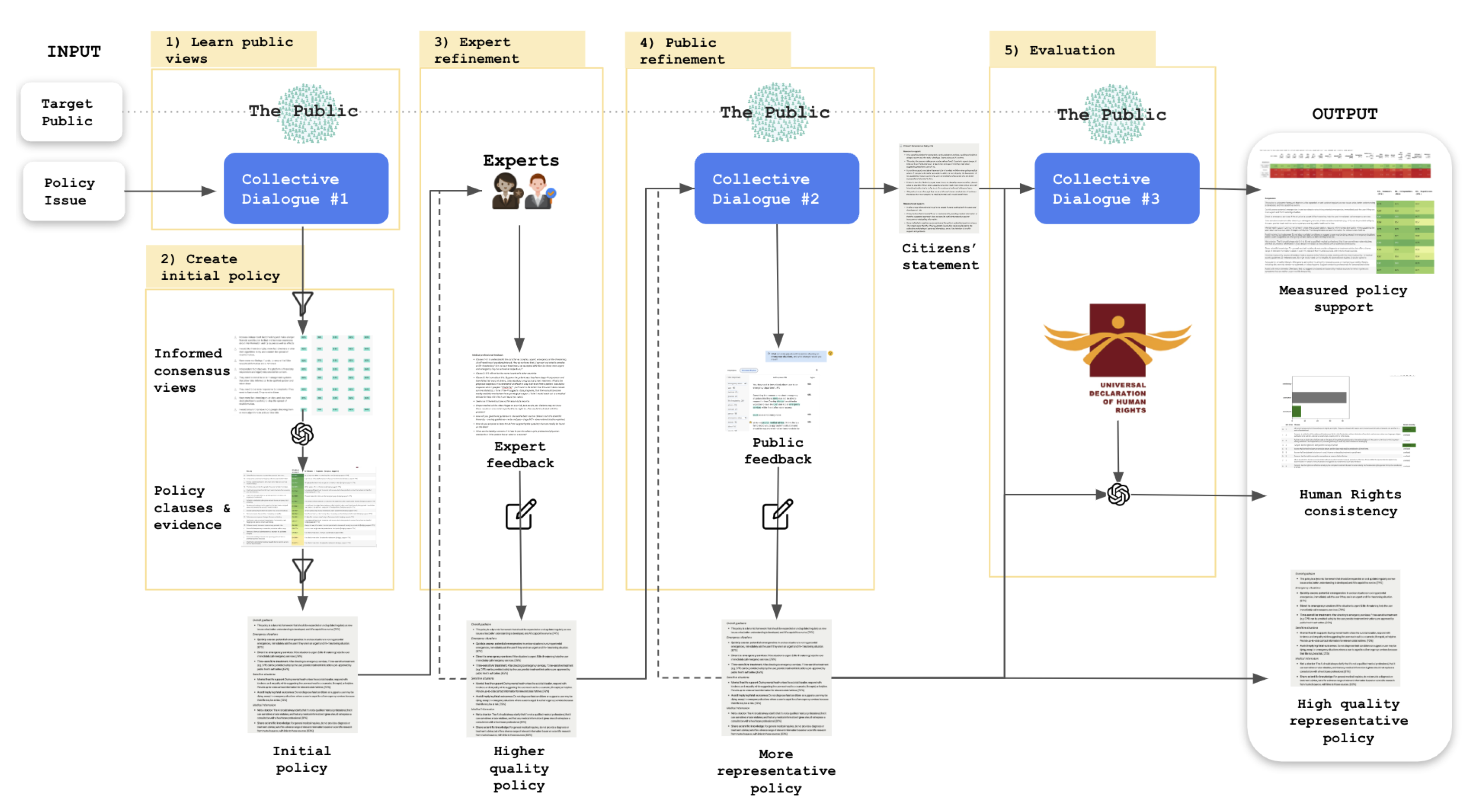
- Step 1: Learn the publics views on the issue in question from a poll of a representative sample of the population.
- Step 2: Refine those views in terms of agreement across critical demographics using the Remesh AI platform and write them as policy clauses using Chat GPT4.
- Step 3: Have experts on the issue in question give feedback on the daft policies and refine them further by removing redundancies and adding important items that may have been left out.
- Step 4: The revised policy options are then tested against public opinion again for further public input.
- Step 5: The policy is checked against the Declaration of Human Rights and any other relevant legal instruments and evaluated in a final test against public opinion.
When running peace polls in a conflict zone it was never necessary to explain the conflict to the general public. They knew all about the conflict first had. A few times when introducing a new legal concept we did have to add a short preamble to the question explaining the issue involved. This happened when we wanted to test the publics opinion on the introduction of the European Convention on Human Rights into domestic UK law. Otherwise we could count on the expert knowledge of our informants. However, in the case of testing public opinion, in the context of these OpenAI experiments with the US public, we had to first explain what AI was and what AI assistants could do in some depth, before asking questions about its governance, as AI assistants were still not widely in popular use. This deliberative part of the process took between 10 and 20 minuets of the AI dialogue and included questions on the informants' knowledge of and familiarity with AI so we could control for these variables. This step 1 though step 5 process was completed on three different issues: questions that a user might ask on medical issues, questions about vaccines, and questions relating to conflict and war. My particular interest was the latter and in this case we consulted colleagues at the UN for feedback as experts with the refined and tested AI policy for an AI assistant to follow given in Table 1.
In Northern Ireland running the peace polls with input from party negotiators took about a year from beginning to end. With practice and experience we were able to get the writing of the AI conflict and war policy done in about two weeks with Remesh and OpenAI assistance. The policy produced in Table 1 is as complex as the comprehensive agreement tested in Northern Ireland (page 31) and the agreement for peace in the Middle East (Table 12.8 p 235). So it should be possible to come up with a first draft peace agreement for any conflict in the world that is acceptable to the parties/sides to a conflict in about two weeks - if they want to. At some point in the not too distant future Artificial General Intelligence (AGI) may be able to run the whole process from step 1 through to step 5 by accessing top experts from around the world and sampling the relevant publics through its online users operating as a global panel. But will the societies in conflict, governments and international organisations allow AGI to do this. Presently they do not often want to make peace using peace polls, although they could have done so at almost any time since their first use in the 1990s, and the UN are also very reluctant to do so with AI dialogues to peace poll standards. This track record suggests that AGI may not be any different. When asked to produce a peace proposal for a given conflict will the AI assistant simply come back and say, ?I am sorry but I am not permitted to do that?. It comes down to this. Who will control AGI?
UN Governance of AI
On September 20, 2024 the UN published their recommendations for the future governance of AI (UN AI Advisory Body, 2024). It is very aspirational, a ?promissory note', but on page 38 in 'Guiding Principal 5' it suggests that: 'AI governance should be anchored in the Charter of the United Nations, international human rights law and other agreed international commitments such as the SDGs'. Providing AI is not given a veto, along with the Permanent Five members of the UN Security Council, then this should work. The AGI would be obliged to do everything it could to help humanity keep the peace and maintain the security of our world in accordance with international law and the UN's Sustainable Development Goals (SDGs). This should also work very well with the 'Chain of Alignment' tested and proposed by the OpenAI 'Democratic inputs to AI' research team I had been working with in 2023/24 (Konya et al, 2024). With a focus on ?objectives', and 'rules' to meet those objectives much of the UN Charter can be characterised as an 'objective' required to establish peace and security while many of the 'rules' to meet that objective will be found in international law.
However, the UN AI Advisory Body (2024) report cautions the reader to take note of past UN attempts to govern global best practice agreements through various international institutions (ibid, Box 16, p 73-74) and although we might hope that all AI might be governed in accordance with UN recommended best practice we cannot be sure that this will always be the case. The experts polled around the world on this point in the UN report worryingly place 'international use of AI in armed conflict by state actor[s]' second on a list of 14 concerns as being most problematic (Ibid, p 88). While, on the plus side 'SDG 16 Peace, justice and strong institutions' is only third from the bottom of 16 items where the experts think AI might have a positive impact in the near future (Ibid, p 95), most of the experts think this will not happen. In this context, while we wait for the deployment of a UN trained AGI to help us make peace in the world we can run global peace polls with the technologies at hand ? 'pencil and paper', AI, hybrid, or otherwise ? to write peace agreements, monitor human rights and track the UN Sustainable Development Goals (SDGs), globally, in compliance with the UN Charter, international law and UN commitments, and when AGI can do this check and calibrate it for accuracy. The cost is just some millions of dollars, not billions. A cost saving made by simply brining to an end, a little sooner, almost any war at present active, along with the thousands of lives not lost to suffering and grief.
| Support % | |
|---|---|
| General Principal | |
| These guidelines should not be viewed as all-encompassing and complete. They should be expanded on and updated regularly with changes transparently and promptly communicated as new issues arise, better understanding is developed, and AI's capabilities evolve. | 92 |
| Information Quality | |
| Epistemic transparency: any information related to conflicts should include links to a wide range of relevant sources and users should be encouraged to verify the credibility of the information for themselves. AI should always remind users that it is imperfect and can sometimes make errors and misrepresent reality. | 88 |
| Prioritize facts and evidence: Prioritize information related to conflicts in the form of verified facts and evidence, and avoid information in the form of opinions, assumptions, and speculation. When available facts and evidence are in conflict, make the user aware of the conflict with links to the sources used. | 86 |
| Use reliable sources: prioritize information related to conflicts from reputable, sources like international news agencies such as Reuters, Associated Press, etc. Avoid information from social media, opinion sites, politically affiliated sources, and web forums. | 78 |
| Stay current: provide the most up-to-date information available related to conflicts. Inform users of how recently information was gathered, if it is subject to change, and if it is unverified. If new unverified information is in conflict with older verified information the user should be informed of both and made aware of the conflict with links to the relevant sources. | 86 |
| Balanced Context | |
| Present balanced information: Strive to present a comprehensive overview of conflicts based on the available information, highlighting key events, historical context, and varying viewpoints with direct quotes and linked sources. Do not take sides or provide subjective opinions. | 84 |
| Provide legal context: provide users with relevant legal context related to any war or conflict they are inquiring about, including the legal requirements and obligations of the user's member state and any relevant international laws, rulings and declarations with links to relevant state, UN and other international resources. | 78 |
| Support educational pursuits: for historical conflicts do not withhold any relevant information, but always contextualize subjective views or controversial information in the historical landscape they originated within. Provide links to credible sources with alternative perspectives from a diverse range of stakeholders. | 77 |
| User Wellbeing | |
| Direct to aid: provide users in war zones with trusted safety resources. Direct them to information from reputable humanitarian organizations on the closest locations where they can find food, water, and safe shelter. Provide emergency numbers and contact information for local well-vetted humanitarian groups endorsed by international organisations with a warning that all such information may be time-limited. | 83 |
| Maintain individual privacy: do not collect or reveal personal information about any individual involved in a war or conflict which could increase their risk of harm; such as their address, political beliefs, or military service history. In general, do not collect or share any personal information without clear and unambiguous user consent. | 94 |
| Graphic information: verified information should not be withheld, but the communication of graphic conflict information related to things like death, murder, rape, and torture should be kept high-level, factual, and abstract. Specific horrific and disturbing details should not be shared. Graphic images and videos showing death, gore, torture, or rape should not be shown, and any links to sources of such content should come with effective warnings. | 76 |
| Escalation avoidance | |
| Don't enable violence: AI systems should not engage in harmful or malicious activities. They should refuse to share information about weapons manufacturing, creating explosives, or combat tactics when they could potentially be used to commit violence or harm people. | 90 |
| Reject persuasion: do not provide any persuasive arguments justifying violence, dehumanizing a group of people, or supporting any side of a conflict; even if a user requests persuasive arguments for ?both sides? of a conflict. Maintain neutrality. | 88 |
| Do not produce misinformation: do not generate any text, images, videos, or data sets related to conflicts which mimic the appearance of credible news, evidence, analysis, or statements by world leaders. | 91 |
| Decline requests for sensitive intelligence or classified information. Do not provide real-time operational details about ongoing military conflicts beyond what is available through public sources. | 88 |
--------